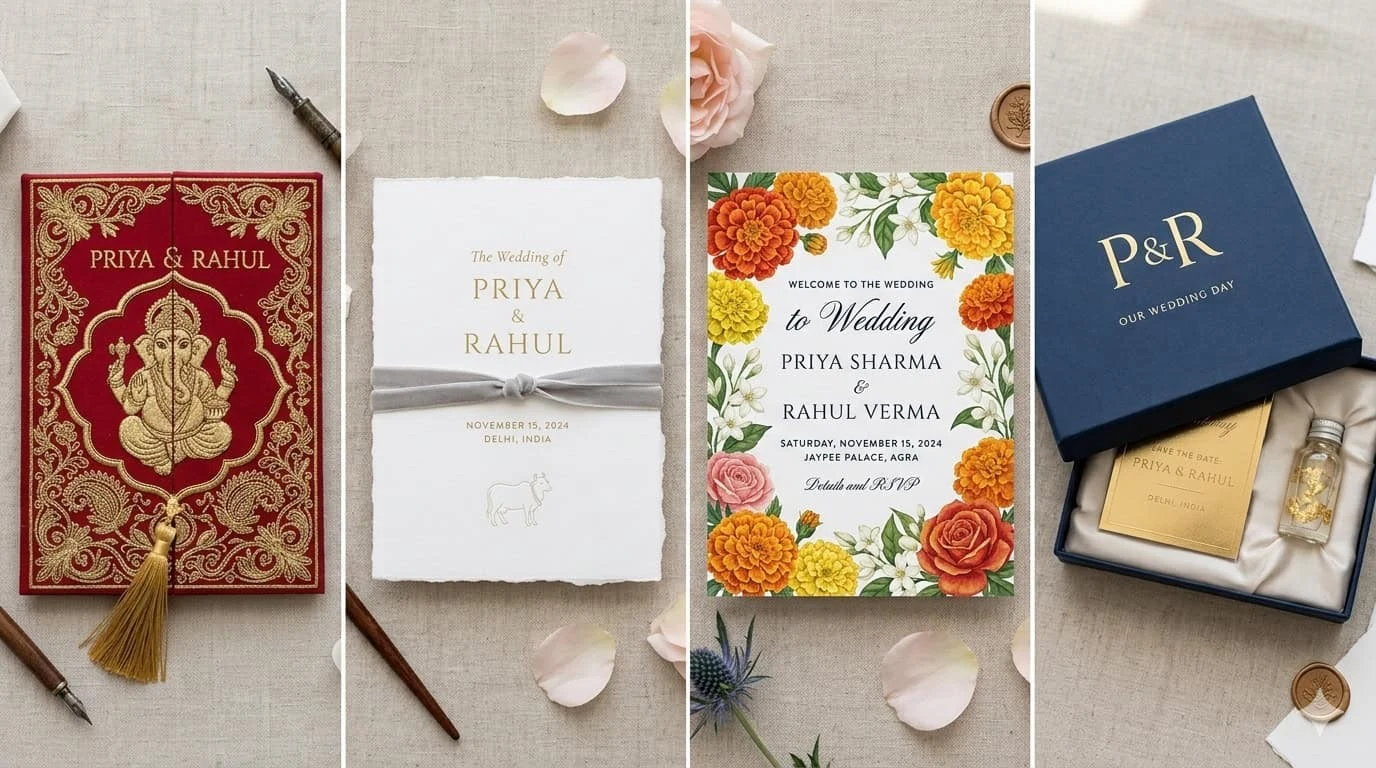
For an Indian wedding, the invitation often has to do much more. It may need to reflect family traditions, religious customs, the wedding theme, the couple's personality and, of course, the practical details guests need to know.
That is why choosing from hundreds of wedding invitation ideas can become confusing. A couple may prefer a simple modern design, while parents may want something traditional. One family may want a premium wedding invitation box, while another may prefer a beautiful card that stays within a fixed budget.
The good news is that you do not have to choose between tradition and personal style.
The right invitation can bring both together.
In this guide, we will look at different wedding invitation ideas for Indian weddings by style, print type, colour, format and budget. You will also learn what to consider before ordering, how to choose a design that works for your family and why ordering a sample can save you from an expensive mistake.
Wedding Invitation Ideas: Quick Guide
Before looking at individual designs, here is a simple way to narrow down your choices.
By style: Traditional Indian wedding invitations,Royal and luxurious invitations,Modern and minimalist invitations,Floral invitations,Cultural or religious-theme invitations,Couple or storybased invitations,Contemporary Indian invitations.
By print type: Offset printing,Screen printing,UV printing,Digital printing,Foil printing,Combination printing
By colour :Red and gold,Maroon and gold,Ivory and gold,Peach and pink,Pastel shades,Green and gold,Royal blue,Deep purple,Cream with metallic accent
By format: Single-card invitations,Folded cards,Multi-insert invitations,Box invitations,Pocketstyle invitations,Scroll-style invitations,Premium invitation boxes
Budget tip
Do not decide your design first and calculate the cost later.
Set a per-card budget before shortlisting designs. Then consider the paper, number of inserts, printing method, envelope, embellishments, packaging and quantity.
A simpler design with good paper and printing can sometimes look more elegant than a heavily decorated card with too many elements.
Find Your Wedding Invitation Style
The first question should not be, "Which card looks the prettiest?"
Instead, ask:
"What should our wedding invitation feel like when someone opens it?"
Should it feel traditional? Grand? Warm? Modern? Elegant? Colourful? Personal?
Your answer will make the selection process much easier.
For Indian weddings, the invitation can also become a meeting point between the couple's preferences and the family's expectations.
For example, a couple may prefer a clean modern layout, while the parents want traditional motifs. Instead of choosing one over the other, you can combine them—a simple layout with an Indian motif, traditional wording with contemporary typography, or a classic colour palette with a modern format.
The current Indian invitation market includes everything from traditional motifs and royal designs to minimalist layouts and digital-first invitations.
What to Consider Before You Choose
Before you start saving dozens of designs, decide these few things with your family.
1. What kind of wedding are you having?
Your invitation should give guests an idea of the celebration they are being invited to.
A large traditional wedding may suit a detailed invitation with multiple inserts or a premium box.
An intimate wedding may work better with a clean, elegant card.
A destination wedding may need additional information such as accommodation, travel details, venue directions and event schedules.
2. How many functions need to be mentioned?
Indian weddings often have more than one celebration.
Depending on the family and community, your invitation may need to include events such as:
-
Haldi
-
Mehendi
-
Sangeet
-
Wedding ceremony
-
Reception
-
Tilak
-
Engagement
-
Other family-specific functions
If several events are involved, make sure the design has enough space for all the information without making the card difficult to read.
3. Who is the invitation mainly for?
Think about your guest list.
If most guests are family members and older relatives, readability should be a priority.
If you are inviting a younger crowd as well, you can experiment with more contemporary layouts, illustrations or digital elements.
The safest approach is to make the important information easy for everyone to read , regardless of age.
4. Do you want tradition, modernity or a combination?
This is one of the most important discussions to have with your family.
You do not necessarily have to choose between a traditional wedding card and a modern wedding card.
For example:
Traditional + modern:
A classic red-and-gold palette with a clean layout.
Cultural + contemporary:
A traditional motif used with modern typography.
Luxury + minimal:
Premium paper and foil detailing without an overcrowded design.
This approach can help couples and parents arrive at a design they both feel comfortable with.
5. What is your quantity?
Always finalise your approximate quantity before placing the order.
Remember to account for:
-
Family members
-
Relatives
-
Friends
-
Colleagues
-
Business contacts
-
Extra cards for last-minute additions
Do not calculate the quantity only from the number of households. Your family's way of distributing invitations may require additional copies.
7 Wedding Invitation Styles for Indian Weddings
Here are seven styles that cover different Indian wedding preferences without forcing every wedding into the same design.
1. Traditional Indian Wedding Invitations
Traditional designs remain a popular choice for families who want their invitation to feel connected to Indian wedding customs.
These designs may include:
-
Traditional borders
-
Religious motifs
-
Paisley patterns
-
Floral motifs
-
Kalash or diya elements
-
Temple-inspired artwork
-
Traditional bride and groom illustrations
-
Classic Indian typography
The important thing is not to put every traditional element onto one card.
Choose one or two strong motifs and let them define the design.
For example, a traditional wedding card can use a detailed arch or floral border while keeping the text area clean.
This works particularly well when parents and elders want the invitation to have a familiar traditional character.
2. Royal and Luxury Wedding Invitations
If the wedding itself has a grand or luxurious feel, a royal invitation can establish that tone from the beginning.
Think about:
-
Rich red
-
Deep maroon
-
Royal blue
-
Emerald green
-
Gold accents
-
Palace-inspired artwork
-
Ornamental borders
-
Foil details
-
Layered cards
-
Premium invitation boxes
A royal design does not necessarily mean adding more decoration.
In fact, a strong royal design often depends on balance . A rich colour, one detailed motif and carefully placed metallic elements can create a more polished result than covering the entire card with decoration.
Beyond Invitation's current collection, for example, includes traditional Indian designs featuring palace artwork, royal colours and illustrated bride-and-groom elements.
If you prefer a more elaborate presentation, designs such as this peach wedding invitation box with peacock motifs can work well for a traditional or luxury wedding theme.
3. Modern and Minimalist Wedding Invitations
Not every Indian wedding needs a heavily decorated card.
Minimal wedding invitations focus on:
-
Clean typography
-
Simple layouts
-
Limited colours
-
White or negative space
-
Small motifs
-
Subtle borders
-
Clear information
A cream card with elegant typography and one traditional Indian motif can look more contemporary without losing its cultural connection.
Minimal designs can also be easier to read, particularly when the card contains multiple event details.
The key is to avoid confusing minimal with plain .
Good paper, typography, spacing and one well-chosen design element can make a simple invitation feel premium.
Minimal invitation styles are also widely discussed in current wedding-industry content as an alternative to heavily decorated Indian invitations.
4. Floral Wedding Invitations
; AA wySX i) 4 7eeDeepika Ff E aa4ee 5 —e ¥e\ enes pee weea” NERY a ee >rasMSS‘ |* mn BiWeSSSy fe Nfs NARS SO
Flowers are a natural fit for Indian weddings and can work across traditional, modern and intimate celebrations.
You can use:
-
Marigold-inspired designs
-
Lotus motifs
-
Roses
-
Jasmine-inspired patterns
-
Watercolour flowers
-
Botanical illustrations
-
Floral borders
-
Small floral corner details
If you want a sophisticated floral invitation, avoid filling every available space with flowers.
A single floral border or a few strategically placed flowers can give the card a softer look while keeping the important information visible.
For a traditional wedding, flowers can be combined with gold and classic typography.
For a modern wedding, try a softer palette with a simple floral illustration.
5. Cultural and Religious-Themed Invitations
= —— :ee—_— pt itSee Pea = 2aaes eh tae oe . ae etSee = No Ww Gey=a. S x, . © ee oe. 6 Re2 | Mh FF
For many Indian families, the invitation is an important way to reflect their traditions.
The design can incorporate elements connected to the family's culture, religion or regional traditions.
Depending on the wedding, this may include:
-
Religious symbols
-
Temple-inspired patterns
-
Traditional scripts
-
Regional artwork
-
Cultural motifs
-
Community-specific design elements
The important point is authenticity.
Do not choose a cultural symbol simply because it looks decorative. If a particular motif has religious or family significance, make sure it is being used appropriately.
This is particularly important when both families are involved in selecting the design.
Beyond Invitation currently organises wedding cards across Hindu, Muslim and Christian categories, reflecting the different invitation requirements found within Indian weddings.
6. Personalised Couple or Story-Based Invitations
Some couples want their invitation to say something about them rather than looking like a standard wedding card.
You can use:
-
Couple illustrations
-
A sketch of the wedding venue
-
A small illustration of how the couple met
-
Initials or a monogram
-
A meaningful location
-
A family-inspired motif
-
A short story or timeline
For example, a couple getting married in Kolkata could incorporate an illustration inspired by a meaningful location rather than using a generic decorative background.
The idea should feel personal without making the card difficult to understand.
The couple's names, wedding date, venue and function details should remain easy to find.
7. Contemporary Indian Wedding Invitations
This style sits between traditional and modern.
It takes familiar Indian design elements and presents them in a newer way.
For example:
Traditional element: Lotus motif Modern treatment: Minimal line illustration
Traditional colour: Red Modern treatment: Deep wine or muted terracotta
Traditional artwork: Palace
Modern treatment: Simple architectural illustration
Traditional typography: Decorative script Modern treatment: Clean serif font
This can be a useful option when the couple wants something current while parents still want the invitation to feel recognisably Indian.
Print Type: Which Printing Style Should You Consider?
The design is only one part of the invitation.
The printing method can change how the final card looks and feels.
Digital Printing
Digital printing is suitable for many detailed designs and smaller quantities.
It can work well when you want:
-
Multiple colours
-
Detailed artwork
-
Photographs or illustrations
-
Flexible designs
Offset Printing
Offset printing is commonly used for printed stationery and can be suitable for larger quantities where consistent colour reproduction is important.
Screen Printing
Screen printing can create a distinct printed finish and may be considered for designs where the print itself is an important visual element.
UV Printing
UV printing can be used for sharp text and detailed elements on suitable materials.
Foil Printing
Gold and other metallic foil effects can add a premium appearance.
Foil can be used for:
-
Names
-
Borders
-
Initials
-
Motifs
-
Headings
But more foil does not automatically mean more luxury.
Sometimes a small amount of gold foil on a well-designed card creates a cleaner result than covering the entire invitation in metallic details.
Beyond Invitation notes that printing costs can vary according to factors such as the type of printing, number of impressions and optional gold foil, so it is worth asking for the printing cost separately when comparing card options.
Choose the Right Colour for Your Wedding Invitation
Colour affects the entire personality of an invitation.
Red and Gold
A classic Indian combination that works especially well for traditional wedding themes.
Maroon and Gold
A deeper alternative to bright red, suitable for a more rich and formal appearance.
Ivory and Gold
A softer combination that can make a traditional design feel elegant and understated.
Pink and Peach
Good choices for floral, romantic and lighter invitation designs.
Green and Gold
Green can work beautifully with botanical, traditional and nature-inspired themes.
Royal Blue
Royal blue can create a strong contrast with gold, cream or white.
Pastel Shades
Pastel pink, peach, sage, lavender and similar shades can work well for contemporary invitations.
A simple colour rule
Try choosing:
1 main colour + 1 supporting colour + 1 accent
For example:
Ivory + sage green + gold
or
Maroon + cream + gold
This keeps the invitation visually organised.
Choose the Right Invitation Format
The format should depend on how much information you need to share.
Single Card
A single card works when your wedding information is straightforward.
It can be ideal when you want a clean and uncomplicated invitation.
Folded Invitation
A folded card gives you more room without creating multiple loose inserts.
It can separate the main invitation from function details.
Multi-Insert Invitation
If you have several functions, separate inserts can make the information easier to organise. For example:
Main card: Wedding invitation Insert 1: Wedding ceremony Insert 2: Reception Insert 3: Mehendi/Sangeet Insert 4: RSVP or additional information
Pocket Invitation
A pocket format keeps several inserts together and gives the invitation a structured appearance.
It can be useful when there are many functions or details.
Box Invitation
For families looking for a premium presentation, an invitation box can turn the card into a complete gifting experience.
Explore our premium wedding invitation boxes for elaborate and gift-ready invitation formats.
A box can hold the invitation along with inserts and, depending on the design, other presentation elements.
Beyond Invitation currently offers premium wedding boxes designed around the "first reveal" of the invitation and also positions them for family gifting and presentation.
Don't Forget the Information on the Card
A beautiful invitation is still not useful if guests cannot quickly understand the important details.
Before sending the card for printing, check:
Names
Check the spelling of:
-
Bride's name
-
Groom's name
-
Parents' names
-
Other family names included on the invitation
Date and day
Check both the date and the day of the week.
Time
Mention the correct time for every function.
Venue
Check:
-
Venue name
-
Complete address
-
City
-
Any important landmark
Function details
Make sure every function that needs to be communicated is included.
RSVP
Add the correct contact details.
Map or directions
If the venue is difficult to locate, consider adding a map reference or QR code where appropriate.
A beautiful invitation is still not useful if guests cannot quickly understand the important details. A typical Indian wedding invitation includes the hosts' names, couple's names, date, time, venue and RSVP details. Indian Wedding Invitation Wording Guide
Wedding Card Ideas That Work for Different Budgets
You do not need an expensive invitation to make a good impression.
Instead, decide where you want to spend your budget.
If You Want an Affordable Invitation
Consider:
-
A single-card format
-
Fewer decorative elements
-
Standard paper
-
Simple printing
-
Limited inserts
-
A clean design
Focus on good readability and a strong colour combination.
If You Have a Mid-Range Budget
You can consider:
-
Better paper
-
Folded or multi-card formats
-
More detailed printing
-
Foil accents
-
Better envelopes
-
Coordinated inserts
If You Want a Premium Invitation
You can explore:
-
Premium paper
-
Multiple inserts
-
Foil work
-
Special finishes
-
Laser-cut elements
-
Premium envelopes
-
Invitation boxes
-
Coordinated presentation
The important thing is to compare the complete cost , not just the card price.
Ask whether the quoted price includes printing, envelopes, inserts, finishing, packaging and delivery.
Order Samples Before You Commit
This is one step that families should not skip.
A design can look completely different on a screen compared with the physical card.
Before placing a large order, check a physical sample whenever possible. Look at:
Paper
Is it thick enough? Does it feel appropriate for the design?
Colour
Does the printed colour look like the digital preview?
Text
Is every word easy to read?
Font size
Can parents and older relatives read the invitation comfortably?
Printing
Are the letters sharp? Are colours consistent?
Foil or special finish
Does the metallic or decorative finish look neat?
Envelope
Does the envelope match the invitation?
Overall size
Does the card feel comfortable to hold, store and distribute?
A sample is especially important for premium invitations because you are paying for the physical experience, not just the artwork.
A Simple Wedding Invitation Selection Checklist
Before finalising your wedding invitation, sit with your family and check these points:
-
Wedding style is decided
-
Approximate card quantity is decided
-
Budget per invitation is decided
-
Main colour palette is selected
-
Number of functions is confirmed
-
Invitation format is selected
-
Paper quality is checked
-
Printing method is discussed
-
Names are spell-checked
-
Dates are checked
-
Timings are checked
-
Venue details are checked
-
RSVP details are checked
-
Sample has been reviewed
-
Final proof has been approved by the relevant family members
That last point matters.
For a family wedding, do not rely on one person to approve the final text if several family members are responsible for providing names, dates or function details.
Frequently Asked Questions
What are the most popular wedding invitation ideas for Indian weddings?
Popular styles include traditional red-and-gold invitations, royal designs, floral invitations, minimalist cards, cultural or religious-themed invitations and contemporary Indian designs. The right style depends on your wedding theme, family preferences, number of functions and budget.
How do I choose a wedding invitation design?
Start with your wedding theme, colour palette, number of functions and budget. Then decide whether you prefer traditional, modern, minimalist, floral, royal or contemporary Indian styling.
What should I consider before ordering wedding invitations?
Check the quantity, design, paper, printing method, colour, format and complete cost. Most importantly, proofread all names, dates, timings, venue information and RSVP details before printing.
How many wedding invitation cards should I order?
The number depends on your guest list and how your family distributes invitations. Count households or recipients according to your actual distribution method and keep some additional cards for last-minute requirements.
Are wedding invitation boxes worth considering?
An invitation box can be useful when you want a premium presentation or have several inserts and additional elements to include. It is generally more appropriate for families looking for a more elaborate invitation experience rather than the simplest card format.
Which colour is best for an Indian wedding invitation?
There is no single colour that works for every wedding. Red and gold suit traditional celebrations, while ivory, pastel, sage, blue, maroon and other combinations can work for modern or contemporary themes. Choose colours that match your wedding style and remain easy to read.
Should wedding invitations be traditional or modern?
They can be either—or a combination of both. For example, you can use a traditional Indian motif with a modern layout. This can be a practical choice when the couple prefers contemporary design while parents want the invitation to retain a traditional feel.
When should I order wedding invitations?
Give yourself enough time for design selection, proof checking, printing and delivery. If your wedding has several functions or a large guest list, allow additional time rather than waiting until the last few weeks.
Conclusion
The best wedding invitation ideas are not necessarily the most expensive or the most elaborate.
They are the ones that make sense for your wedding.
If your family prefers tradition, choose a design that celebrates it. If you and your partner prefer a modern look, you can bring contemporary elements into the invitation without removing its Indian character. If there are several wedding functions, choose a format that keeps all the information organised.
Most importantly, make the decision together.
Talk about the style, colour, number of cards, budget and important family traditions before placing the order. Then check a physical sample and carefully proof every detail.
Your wedding invitation is the first thing many guests will receive from your celebration. It should not only look beautiful—it should feel like your family's wedding .
Whether you are looking for traditional wedding cards, modern designs, premium invitations or simple and elegant options, exploring different wedding card ideas before making your final choice can help you find a design that feels right for both the couple and the family.
If you are looking for Indian wedding invitations, you can explore the wedding card collection at Beyond Invitation , which offers traditional, modern and premium wedding invitation options with delivery across India.